archive
Tokenomics LRC, MATIC, REN, ALCX, BOND
Overview
On May 7, 2019, $LRC is the 2.0 version for the Loopring V2 with the token address here. The
token is ERC-20 compliant and has 18 decimals. Total supply for LRC is 1,375,076,040.
In general there are two types of fees in Loopring: Protocol fee and Layer 2 fee. Layer 2 fees are the small percentage costs that are not volatile to do a zkRollup transaction – fees are paid to the operator (Loopring relayer). Protocol fees, on the other hand, are 20% of the L2 transaction fee.
The newly updated LRC token v2 emphasizes on the incentive for the users that are providing value to the good of the platform. The prior version, protocol fees went to LRC stakers for a minimum of 90 days. The new LRC token model distributes protocol fee as the image below. Specifically for LPs, at least 50% of the 80% portion goes to LRC-related liquidity. Protocol fees are earned and distributed on L2 for the first time on Ethereum.
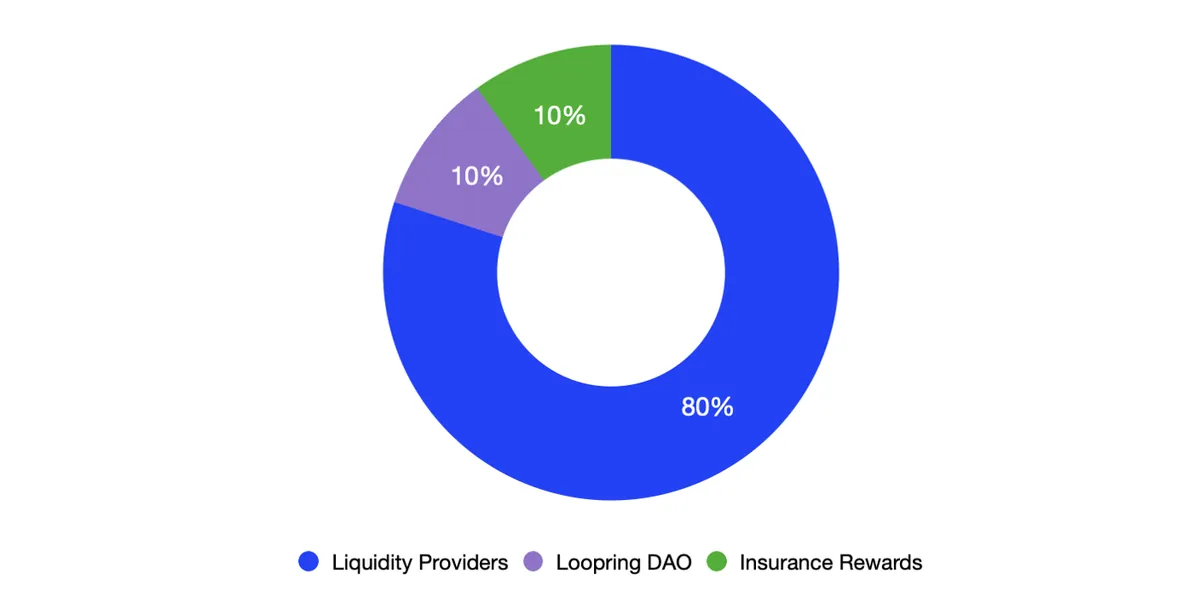
Protocol Fee Distribution (source: here)
Diving further deeper into the fee and token structure model, the current fees generated by the protocol: 0.02% on AMM swaps, 0.046% on order book trades, 0.004% stablecoin trades, and $0.01 on transfers. It is important to note that these fees generate revenue for Loopring.
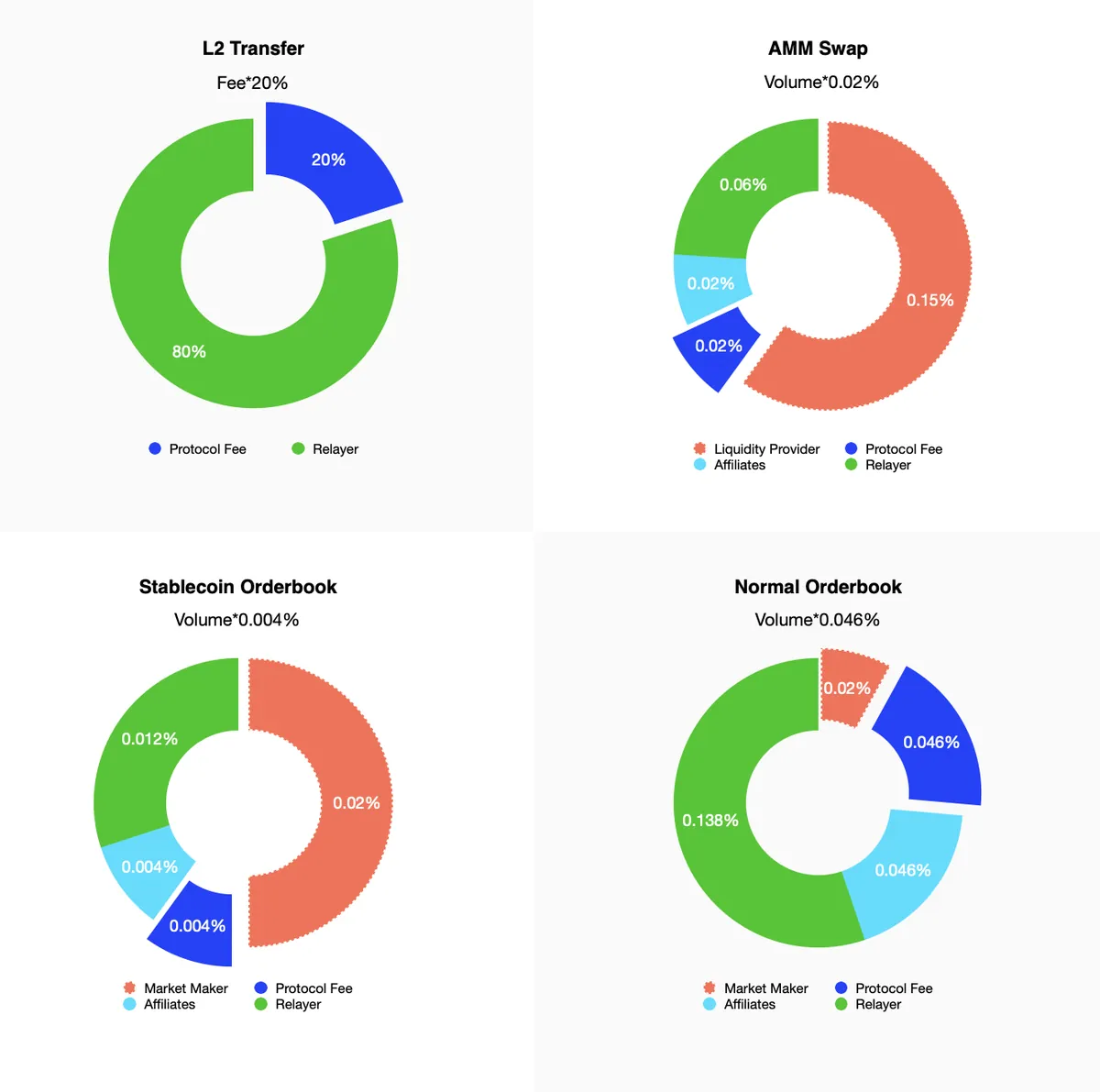
Fees Split Based on Transaction (source: here)
Polygon Tokenomics
Overview
Polygon, previously MATIC, has a native ERC-20 standard token – $MATIC – that powers the entire Layer 2 ecosystem. Currently, it has 6.8B of circulating supply and 10B of total supply.
Use Case
MATIC is a utility token with the main usage being for the longevity of the network: paying gas fees, staking, and governance. The token went on an ICO back on April 26, 2019. During that time, the TGE distribution is as in the chart below.
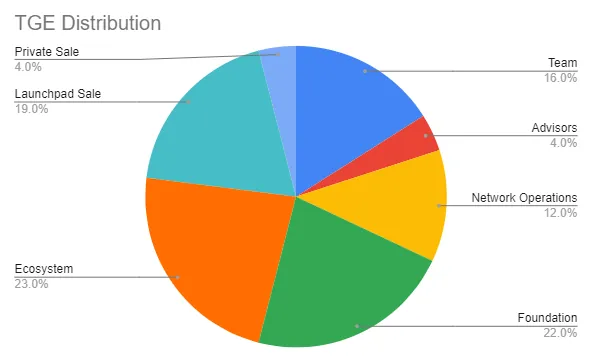
Token Genesis Event Distribution
Emission
The MATIC token itself has a built-in inflationary and deflationary system. Data from here. The inflation rate mainly comes from the staking mechanism – 13.14% yearly. This results in a 7.61 stock-to-flow ratio. To counteract this, the deflationary mechanism comes from the annual token burn. The annual deflation rate according to a medium post is 0.27%.
Note
The developers sold around 3.8% of total MATIC supply in an undisclosed transaction according to the news here.
REN Tokenomics
Overview
The REN token is an ERC-20 based token that has a fixed total supply of 1B.
Use Case
REN is classified as a work token in which its sole purpose is to bond for Darknodes. At REN, Darknodes are similar to a PoS consensus mechanism. Users need to bond 100,000 REN (equivalent to $38,530). The Darknode would earn the users rewards in BTC, ETH, ZED, DAI and ERC-20 tokens.
Emission
The token has a circulating, total, and max supply of 1B currently. This indicates that the real-time price of REN is the true value of the token itself. Hence, there could be no more emission left out of the token. However, an article from medium analyzes the payouts for a Darknode. The writer uses volume entering REN to estimate the revenue generated by a single Darknode. Since 0.1% of the value passing through RenVM will be taken in fees that are shared equally amongst active Darknodes, the general formula would be $Volume\ *\ 0.001\ /\ number\ of\ Darknodes$. As an example, imagine that $100M USD volume passes through RenVM in a single day. With a total number of darknodes of 1000, the daily payout for a single Darknode would be $100.
Alchemix Tokenomics
Overview
ALCX is an ERC-20 based token that has a total supply of 1,414,266 and a max supply of 2,393,060.
Use Case
ALCX is a utility token that has a dual use case of staking and governance. Both of them are interconnected since to participate in voting, users need to earn Voting Points (VP) by staking ALCX.
Emission
The project does not have a hard cap, instead it is replaced with an emission schedule. The numbers below are based on a rough estimate by the team from the total expected supply after three years of Alchemix v1 docs published. After the 3 years period, Alchemix DAO will receive 15% + 5% of the total projected supply. The latter for bug bounties program and the former is at the community’s discretion. Alchemix founders, devs, and community devs will have access to an exclusive staking pool – rewarding them 20% of the ALCX block reward (roughly 16% of total supply). The public users that are staking have the other 64% portion of the staking emission.
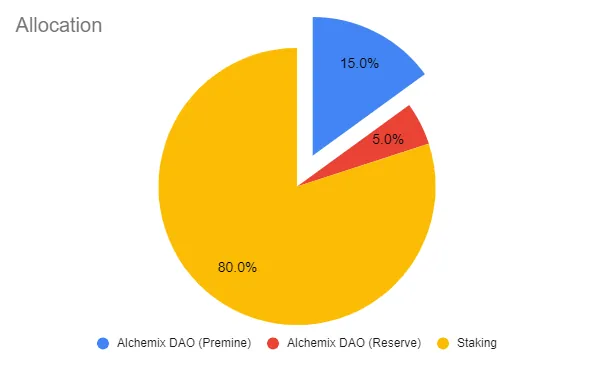
Token Emission Distribution
Initially, around 22k ALCX will be distributed from staking in week one; this amount would decrease gradually by 130 ALCX per week for three years – ending the final emission rate with 2,064 ALCX per week. The estimated annual inflation rate at year three would be 4.5%. Currently, there are no plans to add a deflationary system in the token.
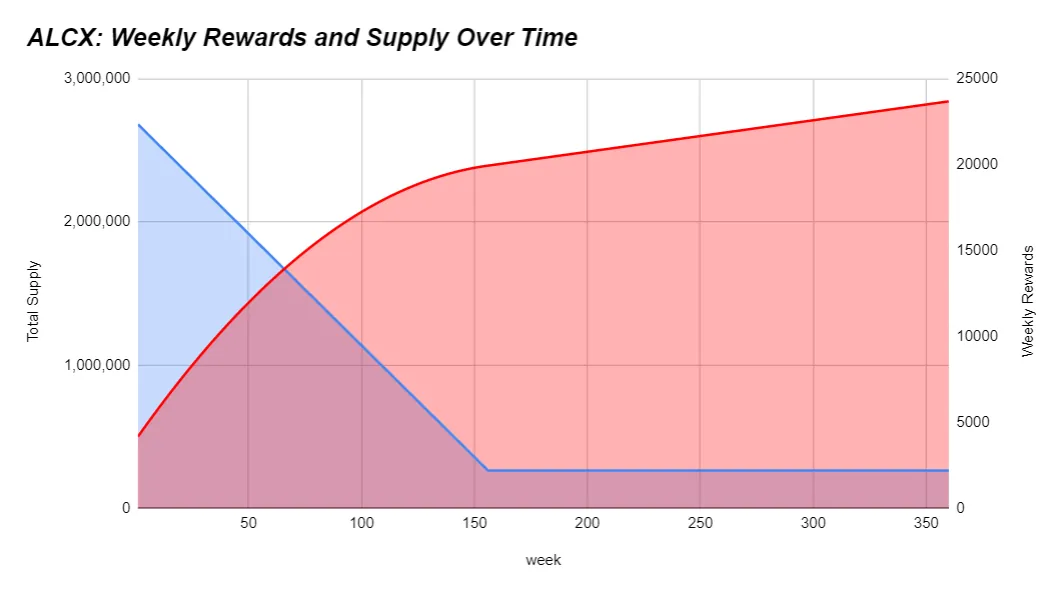
Alchemix Supply and Staking Rewards Over Time (source: here)
BarnBridge Tokenomics
Overview
$BOND is an ERC-20 token that has a use case of staking and governance with the current circulating supply 6,359,840 BOND.
Use Case
BOND is a utility token that has a main use case of staking and governance (when the module has launched).
Emission
BOND has a total and max supply of 10M. The team has a vesting schedule of 100 weeks. The image below accurately displays the total token distribution.
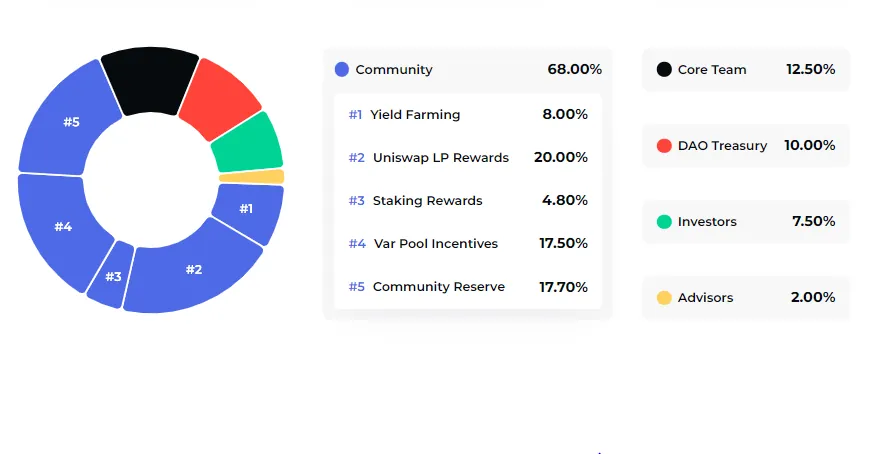
Token Distribution (source: here)
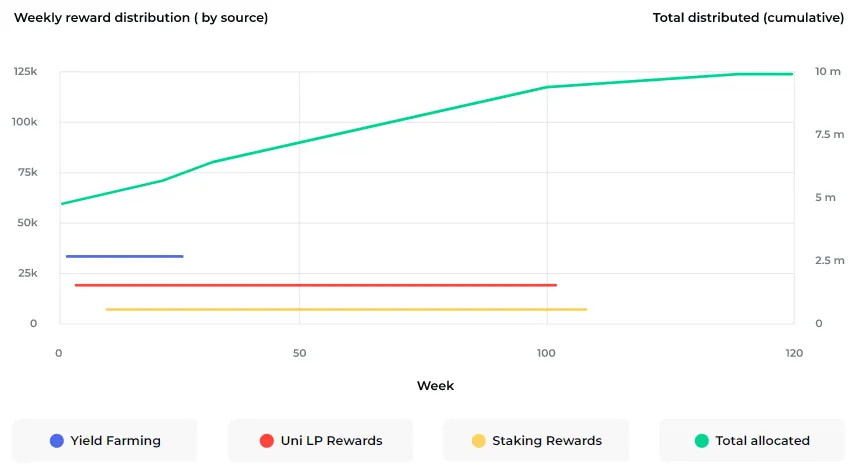
The vesting period for BOND begins with the launch of yield farming mechanism. The total amount of $BOND allocated to Founders, Investors, and Advisors are 22% (2,200,000 token) with a linear vesting rate.