archive
Marketing Strategy for Crypto Wallets in Indonesia
Executive Summary
Hosting a crypto wallet in Indonesia should have the target market of millennials that reside in big and developed cities. People between the age of 17 - 30 are the most interested ones around the blockchain industry. These people usually are located in matured cities i.e. Jakarta, Tangerang/BSD, Bali, and Surabaya. Advertisement would also definitely be a great idea especially when partnering with high net-worth or social media personalities.
This article is going to deep dive into the opportunities of creating a crypto wallet in Indonesia. The format is as follows: data is presented, then Takeaway for the metrics itself.
Population/Important Cities
Looking at the geographical location to start marketing a crypto wallet, the first data to look into is the minimum wage of each city since higher wages might indicate that the circulation of money is high and people have the opportunity to spend/invest more from their income.
Furthermore, the most prevalent city is Jakarta – the heart of Indonesia, followed by Surabaya – filled with people with ‘old money’, Bandung – the city of college students, Bekasi – similar to Karawang (industrial district), Tangerang/BSD – most middle to upper class families live here, Bogor – government officials usually reside around here, Jogja – traditional and culture-centric city of Indonesia.
Takeaway: do note that each geographical city has its own pros and cons, complemented with their own unique culture. In general, however, the best marketing strategy for geographical location is to target the already big cities (i.e. Jakarta, Surabaya, and Tangerang).
Regulations
Mobile Phone Culture
We are going to take a top-down approach to explore Indonesia’s mobile phone culture. The number of people that have a mobile phone in Indonesia for the year 2020 reached a high of 183.68M. Statista forecasted that by the year 2026 there will be 238.79M of people that have a mobile phone.
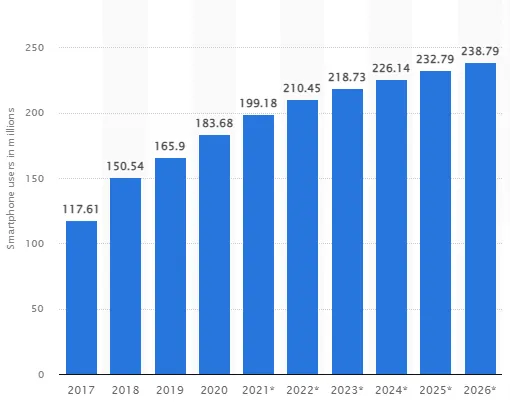
Number of Smartphone Users from 2017 to 2020 with forecast until 2026 (source: here)
Now, classifying these numbers of smartphone users by age, around 60% smartphone users in Indonesia are between the ages of 16-24.
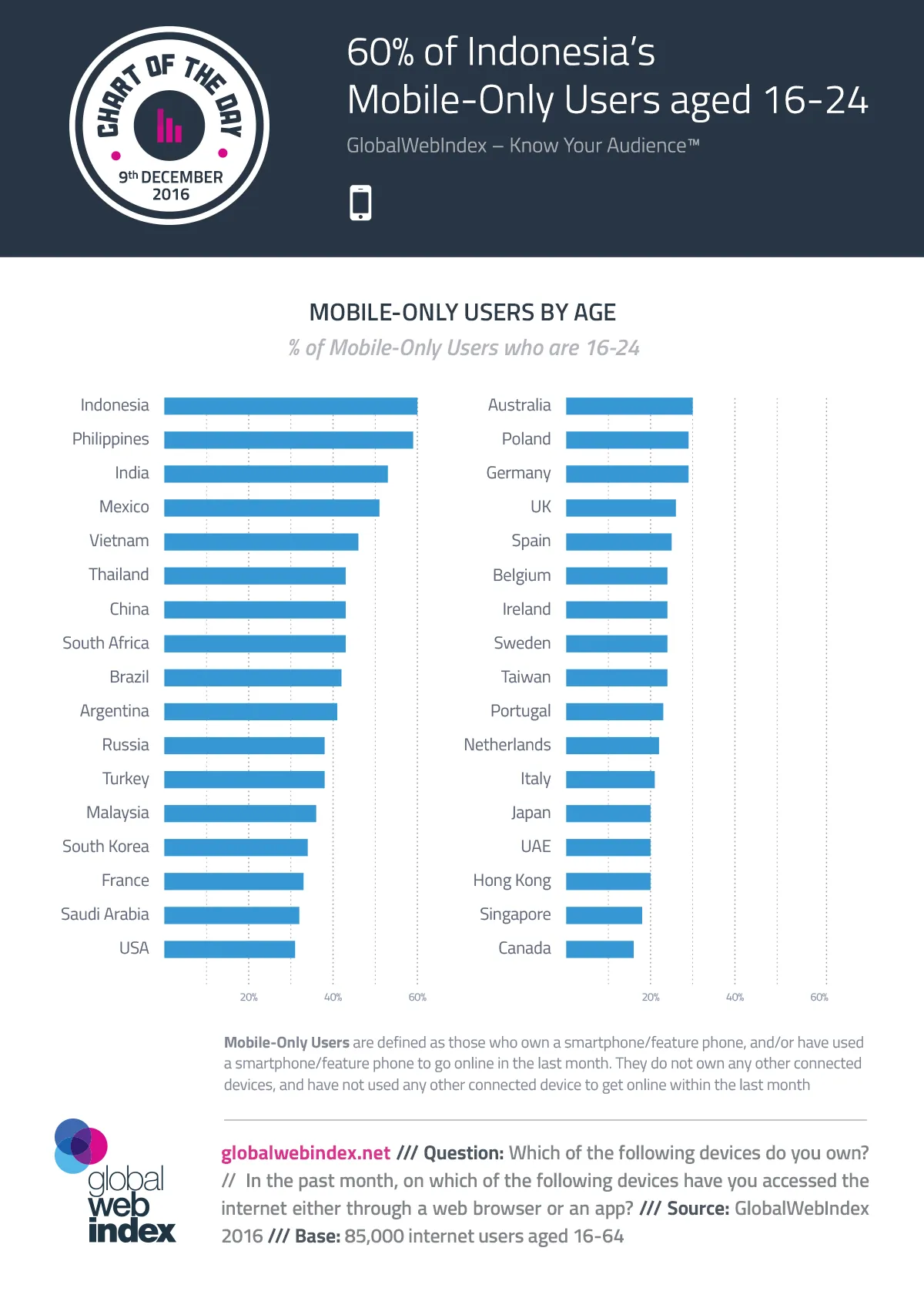
Number of users by ages 16 to 24 (source: here)
Another key metric to look into for the mobile phone culture is the penetration rate.
The result is derived from the formula $Penetration\ Rate\ = \ \frac{#\ of\ people\ owning\ x}{Total\ #\ of\ population}$.
In this case, penetration rate indicates the % of people that adopt smartphones compared to the total population. Data from Statista points out that in the year 2020, the penetration rate from Indonesia has reached 67.15% and is expecting growth to 82.45% by the year 2026.
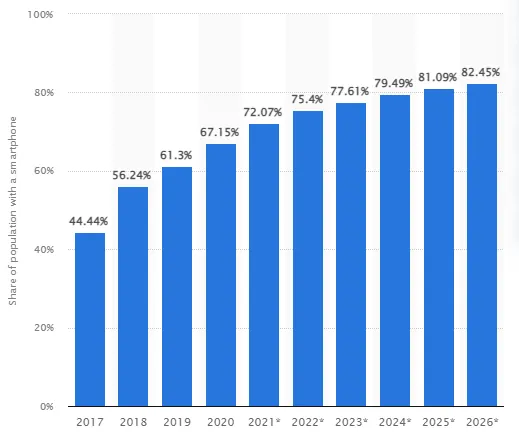
Penetration Rate (source: here)
Deeper into the smartphone culture in Indonesia reveals that most Indonesians use Samsung (21.94%), Oppo (21.28%), Xiaomi (19.83%), Vivo (12.27%), and Apple (8.89%). This indicates that most Indonesians currently have Android-based smartphones instead of iOS.
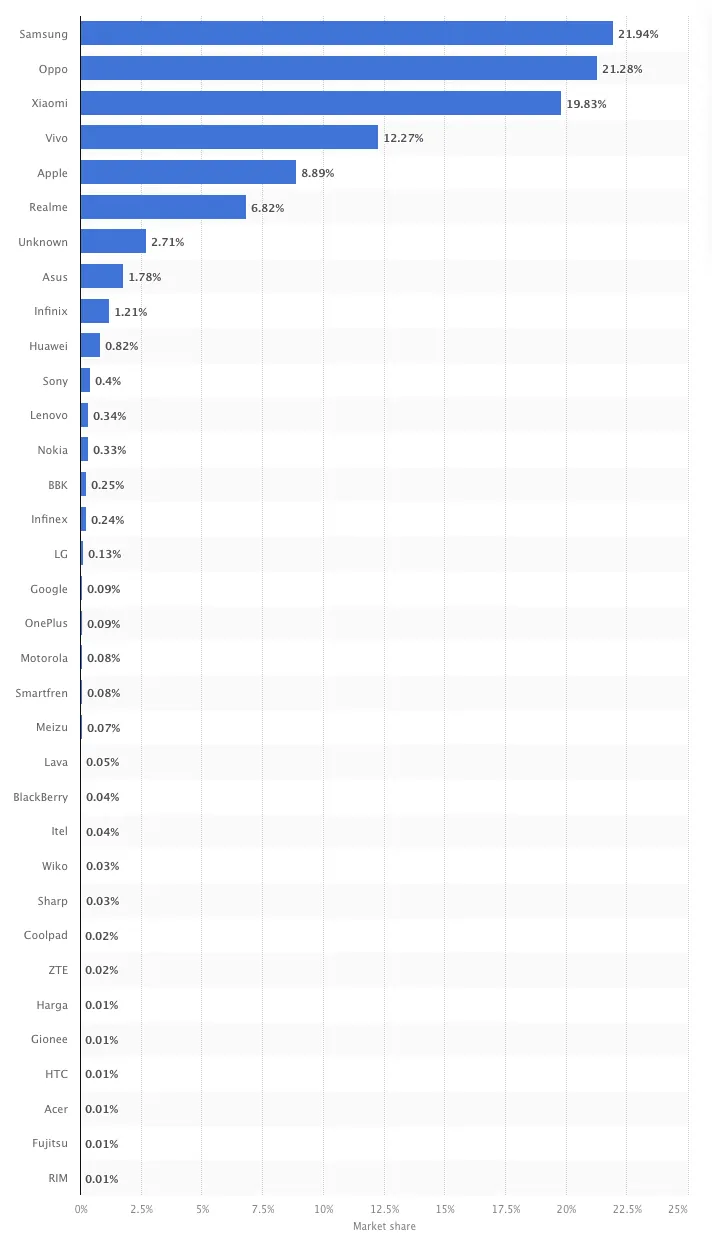
Market Share of Leading Mobile Vendors July 2021 (source: here)
Another deep dive into the smartphone by vendor share in Indonesia indicates that the most people using Android-based phones are around the age of 26-30 with the brand Samsung. iOS users are dwarfed with most people around the age 18-30 using it.
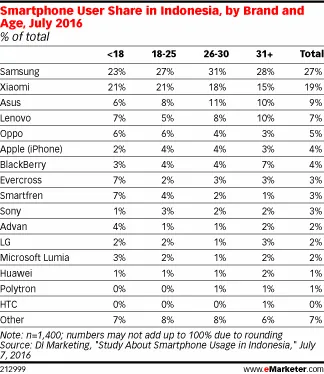
Smartphone User Share by Brand and Age (source: here)
Interestingly, an article (here) indicates that people of Indonesia spend 5.2 hours/day on their smartphones. This is higher than India – where the total population is vast than Indonesia.
Takeaway: Android-based OS phones to create a crypto wallet is the way to go compared to iOS users. Indeed, people using iPhones may be between the middle to upper class (personal opinion), though the target market is much larger for Android-based OS phones.
Top Social App
Around 62% of the total population in Indonesia are users of social media platforms. Amongst the most-used platforms are YouTube, Whatsapp, Instagram, and Facebook. Do note that the last three are under Meta’s (formerly Facebook) control. 65% of the population aged 13+ are on Facebook, on the other hand, 42% of the population aged 13+ (around 107M) are on YouTube. Additionally, YouTube’s penetration rate for Indonesia is as high as 94% as of Q3 2020.
Another several social media apps that may be worthwhile to look into are TikTok and Telegram. The COVID-19 situation has driven people to work from home, hence it opens up a possibility for another social media platform primitive. Come TikTok with its 10-60s video format. During the pandemic, the platform has seen its rise of exposure and most unrecognized influencers started to grow their content there. The other platform to look into is Telegram, which promotes privacy compared to its direct competitor – Whatsapp. Telegram has its own community for crypto enthusiasts or traders alike since they could easily hop on or off the channel.
Takeaway: The top social media app to do marketing is actually TikTok, followed by YouTube, and Instagram. TikTok is unique because of its social media format – short videos.
Payment Culture
This metric will be covered between traditional banking systems and FinTech systems. An article indicates that Indonesia is the APAC’s most valuable untapped money market – around 66% Indonesians do not own a bank account. 20-30% of Indonesians use mobile banking (source here here). The image below shows the distribution of people owning a bank account by age.
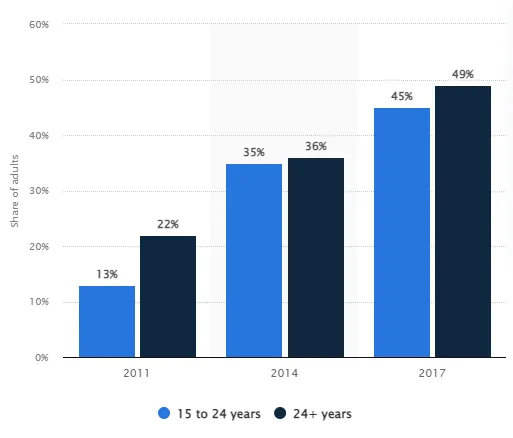
Share of Adults Owning an Account at Financial Institution (source: here)
Indonesia has more than 167 FinTech companies with sub-sector including payment, lending, personal finance, crypto and blockchain, crowdfunding, insurtech, and Point of Sale services (source: here). Its market capitalization is around 4% of Indonesia’s GDP – 27.547T (source: here). Whereas, the loan is around 88.37T (source: here). An article covering Indonesia’s FinTech report indicates that 84% of FinTech users are below the age of 54 (source: here).
Takeaway: Crypto wallet in Indonesia might need to go hand in hand with FinTech companies since most of the FinTech companies adopter are mostly millennials.
Monopoly
In this case, monopoly refers to monopolists for mobile/FinTech payments. To date, E-Money transactions have reached an astonishing 15.8T IDR. Furthermore according to data from Statista, Indonesians mostly use either GoPay, OVO, or Dana as the go to choice for digital wallet. The result was around 93% of the total 1493 respondents used either of those wallets. Complementing this, most respondents between the age 18 to 40 used GoPay as the first digital wallet.
Takeaways: Partnering with one of the three giant monopolists in FinTech payment can provide large benefits.
Local Partnership
This part mainly comes from personal opinion.
Most business-oriented universities in Indonesia promote their students to create a small business as a requirement for them to graduate. Several of these universities include Universitas Prasetya Mulya and Universitas Pelita Harapan. Partnering with these college students creating small businesses could provide a worthwhile opportunity in the exposure to millennials of their age.
PPV, PPC
This part is under the assumption that Indonesia has the same cost to other countries in social media app advertising.
The cost to advertise in YouTube is $0.01-$0.03 per view, TikTok starts at $10 per CPM (cost per 1,000 views) and requires a minimum of $500 on a campaign, and Instagram costs $0.4-$0.7 per click.
Takeaway: Each of the social media apps have their own unique format with their own pros and cons. Cost-wise YouTube is much better than the others since it is cheaper, however do note that YouTube users also have the option to skip ads.
Notable Blockchain Projects/Influencers/Founders
The first and foremost blockchain-oriented project is the Asosiasi Blockchain Indonesia (ABI) since the members are mostly investors and they have experiences in the financial and blockchain industry. Another notable blockchain project is Paras.id – an NFT marketplace in the NEAR protocol offering a unique method of selling NFTs.
There are several options for companies to partner with. Tokocrypto – CEX invested by Binance, Pintu – CEX, Intudo Ventures – a VC that invested in Pintu (mainly focusing on UMKM), Indodax – Indonesia’s crypto marketplace.
For social media, there are more opportunities! Partnering with the creators and group of Karafuru would be a worthwhile option since most of them are social media personalities/celebrities. Another option of high net-worth people are owners of Trinity Land – real estate developer that recently the creators went into crypto, Belvin Tannadi (BelvinVVIP) – technical trader that have the influence to pump or dump the market, Tukang Trader – day trader, Andy Senjaya – Technical stocks/crypto trader, Ellen May – Long term investor in the capital market, Michael Yeoh – Capital market/crypto trader. Several other options for currently growing social media personalities are Kaptencrypto, blockchainmedia, and cryptomedia.