archive
Polygon
Executive Summary
Polygon (MATIC) is an Ethereum layer 2 scaling solution that provides flexible frameworks for developers to build and connect layer 2 infrastructures such as Optimistic Rollups, zkRollups, and more. Its core product is the Matic Proof-of-Stake. MATIC is Polygon’s native token.
The Polygon foundation was started in 2017 in Bangalore, India, and the British Virgin Islands. The project published its whitepaper in July 2020. The whitepaper was written by founders Jaynti Kanani, Sandeep Nailwal, and Anurag Arjun. Originally known as Matic, the entity went through a rebranding to Polygon in February 2021 and released its flagship product a year before in June 2020.
Polygon Proof-of-Stake
The value proposition of Polygon scaling solution is to create a network of various chains and smart contracts that are eventually tied back to the Ethereum main blockchain. This enables faster transaction speed and efficiency while relying on the security of the underlying Ethereum blockchain. In essence, it removes computation and transactions’ storage from the Ethereum blockchain to the different sidechains.
What helps distinguish Polygon amongst the other promising scaling solutions is that the network extends beyond a singular provision of its flagship product, the Polygon commit chain. The platform brings in connectivity amongst other scalability applications including individual chains also called plasma chains and other L2 applications such as Optimistic and Zero-Knowledge (ZK) rollups.
State of Polygon
Polygon is often bucketed into a layer 1 or smart contract basket due to the fact that it has its own set of validators securing the Polygon’s PoS network. Despite its claim to be a layer 2 solution for Ethereum, its underlying architecture doesn’t rely on Ethereum’s security in its entirety. As the crypto industry continues to mature, Polygon needs to decide on where they land, in order to have a much more clear value proposition.
The chain has seen exponential growth as it offers cheaper fees for DeFi users and its EVM-compatible structure makes it easy for ETH-based projects to adopt. This means that capital can flow to Polygon much easier compared to other layer 1 non-EVM compatible chains such as Solana.
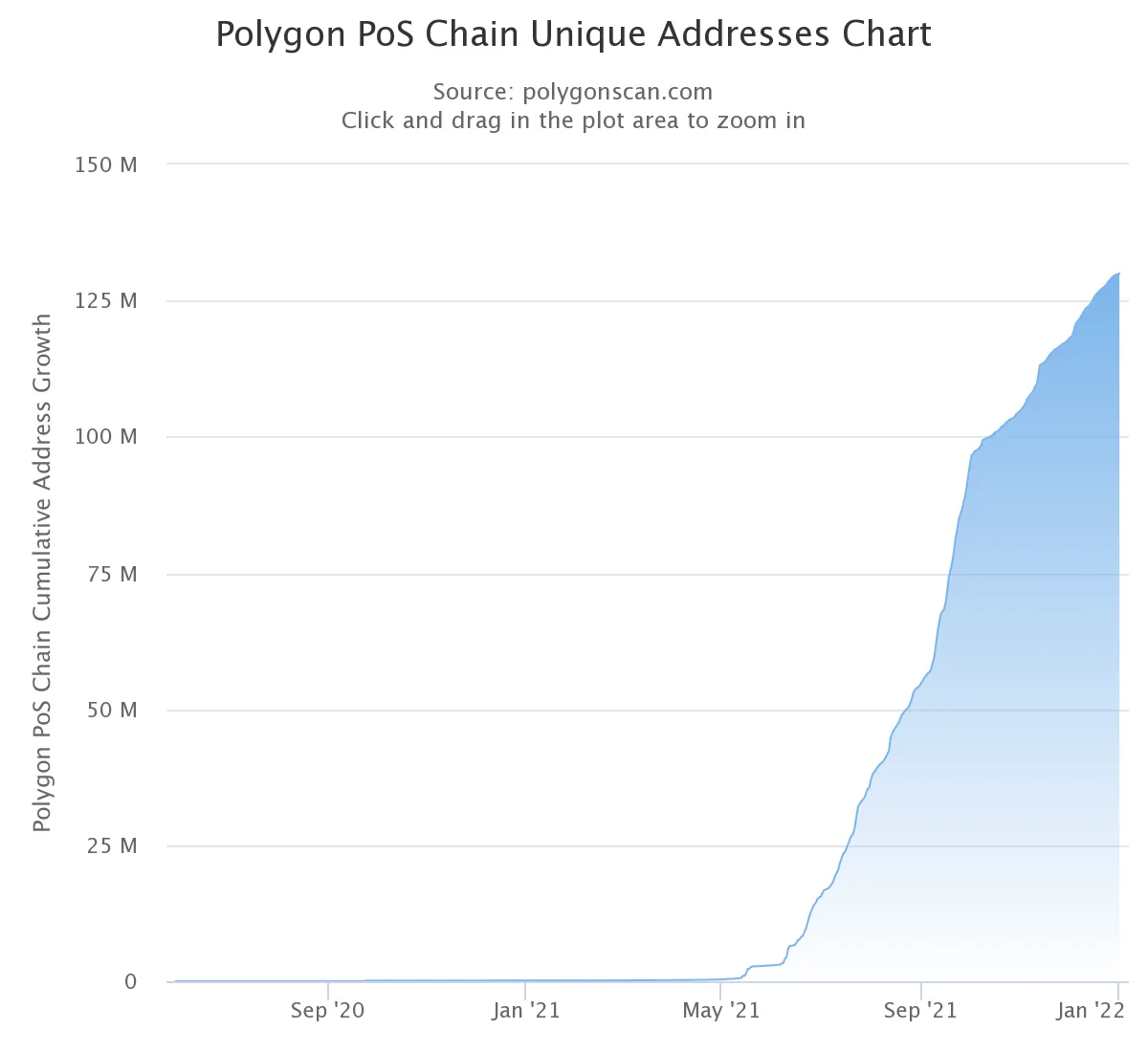
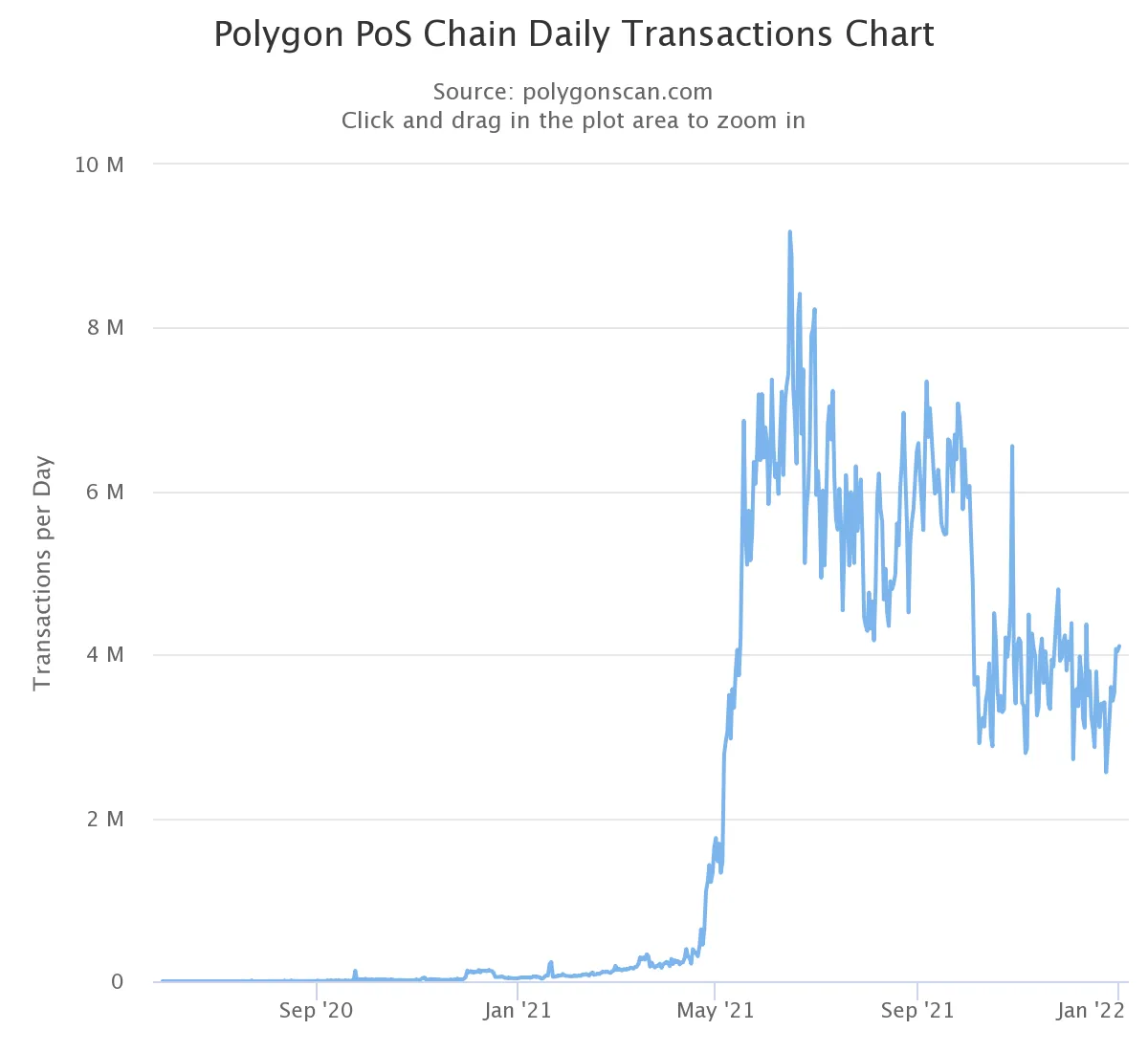
That said, Polygon’s recent fiasco regarding code changes, centralization issues, and vulnerability issues have caused the number of transactions conducted on the chain to drop by more than 50% compared to its peak. Additionally, this timing coincides with the launch of many Ethereum layer 2 scaling solutions such as Optimism and Arbitrum, adding competition to the ecosystem that Polygon is trying to play in.
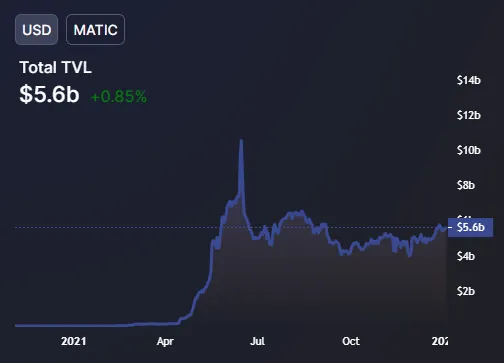
The growth of Polygon’s DeFi ecosystem has also stagnated. Although there are a few Polygon-first projects such as Quickswap, the majority of DeFi apps on Polygon are ETH-based projects that actively try to go multi-chain. Only 3 out of the top 20 DeFi projects by TVL in Polygon are a Polygon-first project.
Team and Investors
Polygon was founded by Jaynti Kanani, Sandeep Nailwal, and Anurag Arjun. The team roughly holds 16% of the total MATIC token supply.
The project did a $5.6M ICO in April of 2019 and has since raised approximately ~$450k additional funding from publicly available information. It is not known whether MATIC token fundraising mechanism has been conducted via OTC deals. The project recently launched a $200M ecosystem VC fund in partnership with Reddit’s co-founder Alexis Ohanian’s Seven Seven Six VC firm.
Tokenomics
MATIC token has a total supply of 10,000,000,000 tokens. Approximately 68.72% of its token are currency in circulation with a market cap of $17B and an FDV of $24.7B. These metrics make MATIC one of the best “smart-contract related” tokens when it comes down to its future forecasted valuation.
Launchpad sales, early supporters, private sales, and seed rounds combined accumulate to roughly 24% of the total token supply.
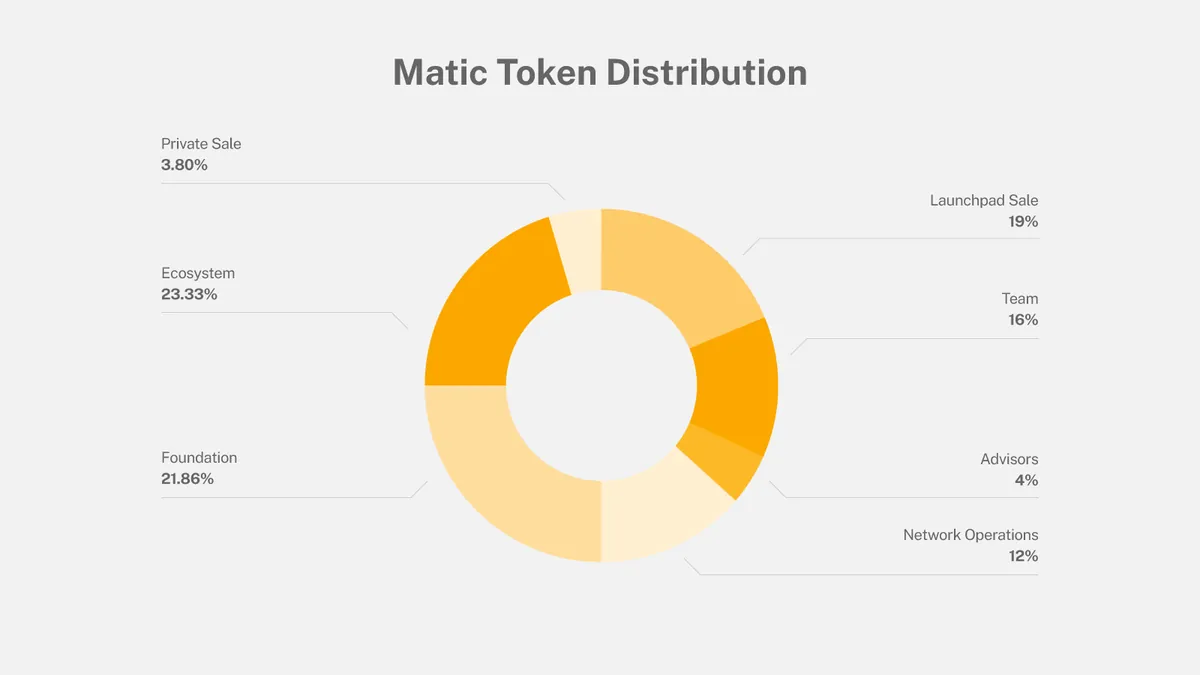
360 million AVAX supply distribution
Quantitative
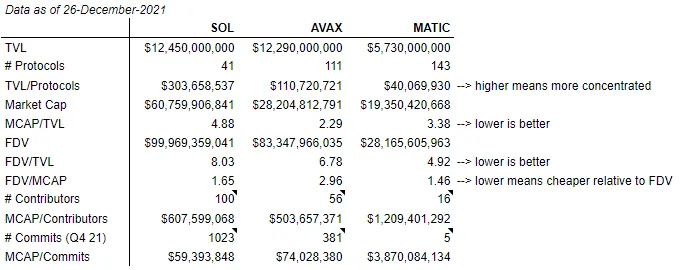
Approximately 1/4th of Polygon’s Market Capitalization consists of value locked in the network, which is pretty low compared to other pure-play layer 1 blockchains. Its Fully Diluted Valuation, however, indicates that it is less likely for MATIC to lose value due to token dilution in the future. Lastly, the development activities in MATIC’s main GitHub repository seem to be lacking as of recently (past two quarters). This is not a positive sentiment considering the fact that the timing coincides with the launch of other layer 2 solutions for Ethereum.
Conclusion
- good free float, less likely to lose value because of token dilution
- vulnerable to other ETH scaling solutions taking the limelight
- value accrual mechanism is not as clear as it acts as an ETH sidechains
- developer activities have been slowing down